
Habitual Balance Travel

How to Stop Living on Autopilot: A Practical Guide to Becoming More Intentional

Welcome to this Habitual Balance guide on breaking free from autopilot living and creating a more intentional life. If you’ve been feeling emotionally exhausted, mentally disconnected, stuck in repetitive routines, or simply like life has started blending together, you’re definitely not alone. Many of us spend years moving through responsibilities, distractions, and expectations without slowing down long enough to ask ourselves whether we’re truly enjoying the direction we’re headed in. This guide is here to help you reconnect with yourself, challenge unhealthy patterns, embrace growth, and begin making small but meaningful changes that create a more fulfilling life over time. You do not need to completely reinvent yourself overnight. You simply need to start becoming a little more aware, intentional, and present each day.

1. Recognize the Signs of Autopilot Living

Sometimes we become so consumed by routines that we stop questioning whether those routines are actually making us happy.

Autopilot living often feels “normal,” which is why it can be difficult to recognize at first. Many people wake up, scroll endlessly through their phones, rush into work, come home exhausted, consume entertainment for hours, sleep, and repeat the cycle over and over again without ever slowing down enough to think deeply about their lives.

Signs You May Be Living on Autopilot:

  • Constant doom scrolling
  • Feeling emotionally numb or disconnected
  • Repeating the same routines daily without excitement
  • Living mostly for weekends or vacations
  • Staying busy to avoid deeper thoughts
  • Feeling mentally exhausted even after resting
  • Rarely trying new things or challenging yourself

The scary part is that many people stay trapped in these cycles for years because they assume this is simply what adulthood is supposed to feel like.

But life should feel experienced, not merely tolerated.

Small Action Step:

Spend one full hour today without:

  • your phone
  • television
  • social media
  • notifications

Go outside. Sit quietly. Journal. Take a walk. Let your mind breathe for a while.

2. Stop Overthinking Every Next Step

One of the biggest traps that keeps people stuck is overthinking.

Many of us convince ourselves that we’re making progress simply because we’re constantly thinking about improving our lives. But thinking and doing are not the same thing.

Overthinking often creates paralysis:

  • waiting until the timing feels perfect
  • waiting until you feel fully confident
  • researching endlessly without action
  • comparing your timeline to everyone else’s

The truth is that clarity usually comes after movement, not before it.

What Overthinking Can Look Like:

  • Starting and stopping goals repeatedly
  • Fear of making the wrong choice
  • Constantly needing reassurance
  • Putting dreams on the “back burner”
  • Avoiding action because you don’t feel “ready”

Habit to Try:

Implement the “5 Minute Rule.”

Choose one meaningful goal and commit to working on it for just five minutes each day.

That’s it.

Five focused minutes:

  • writing
  • exercising
  • meditating
  • learning a skill
  • organizing your life
  • building a business idea

Small actions repeated consistently create massive changes over time.

3. Build Long-Term Growth Instead of Chasing Quick Fixes

Personal growth is not a quick transformation.
It’s a long game.

We live in a culture obsessed with instant results, but meaningful change usually happens quietly and slowly. Most of the time, growth is happening underneath the surface long before anyone notices it, including yourself.

That can feel frustrating.
But it’s normal.

Truths About Long-Term Growth:

  • Growth is rarely linear
  • Motivation comes and goes
  • Consistency matters more than intensity
  • Healing takes time
  • Identity shifts happen gradually
  • Small habits shape long-term outcomes

There may be moments where you feel stuck or discouraged because your life is not changing as quickly as you hoped. But if you continue taking intentional steps forward, progress will eventually compound.

30-Day Challenge:

Choose ONE area of life to intentionally improve for the next month:

  • sleep
  • nutrition
  • movement
  • reading
  • mindfulness
  • journaling
  • reducing screen time
  • financial habits

Do not try to fix your entire life at once.

Focus on one area and build momentum slowly.

Reminder:

Your journey does not need to look like anyone else’s to still be meaningful.

4. Learn to Become Comfortable Being Uncomfortable

Growth often requires discomfort.

Many of us spend years avoiding anything that feels emotionally difficult:

  • hard conversations
  • vulnerability
  • failure
  • rejection
  • uncertainty
  • physical discomfort
  • emotional honesty

But avoiding discomfort usually creates even deeper suffering over time.

Sometimes the pain we avoid today becomes the life we feel trapped in tomorrow.

The reality is that some discomfort is necessary if we want to grow stronger mentally, emotionally, or physically.

Discomfort Can Look Like:

  • setting healthier boundaries
  • trying new experiences
  • speaking honestly
  • exercising consistently
  • confronting fears directly
  • changing unhealthy habits
  • stepping outside comfort zones

Pain is not always destructive.
Sometimes it is transformative.

Reflection Prompt:

Ask yourself:

“What discomfort am I currently avoiding that could actually improve my life?”

Write down your answer honestly.

You may be surprised by what surfaces.

5. Start Creating a Life You Actually Enjoy

At some point, many of us realize we do not want to merely survive life anymore.

We want more:

  • more peace
  • more freedom
  • more presence
  • more experiences
  • more connection
  • more meaning

But thriving does not always require a dramatic life overhaul.

Sometimes thriving starts with intentionally creating small moments that make you feel alive again.

Ways to Thrive More Intentionally:

  • Schedule small adventures
  • Spend less time consuming content
  • Build hobbies outside of work
  • Prioritize experiences over distractions
  • Create boundaries around your energy
  • Spend more time in nature
  • Practice gratitude more consistently
  • Slow down enough to actually enjoy your life

The little things matter more than we often realize.

Mini Challenge:

Plan one intentional experience for yourself this month:

  • hiking
  • camping
  • visiting a new coffee shop
  • taking a solo day trip
  • attending a class
  • trying a new hobby
  • spending a day offline
  • reconnecting with an old passion

Life feels more meaningful when we actively participate in it.

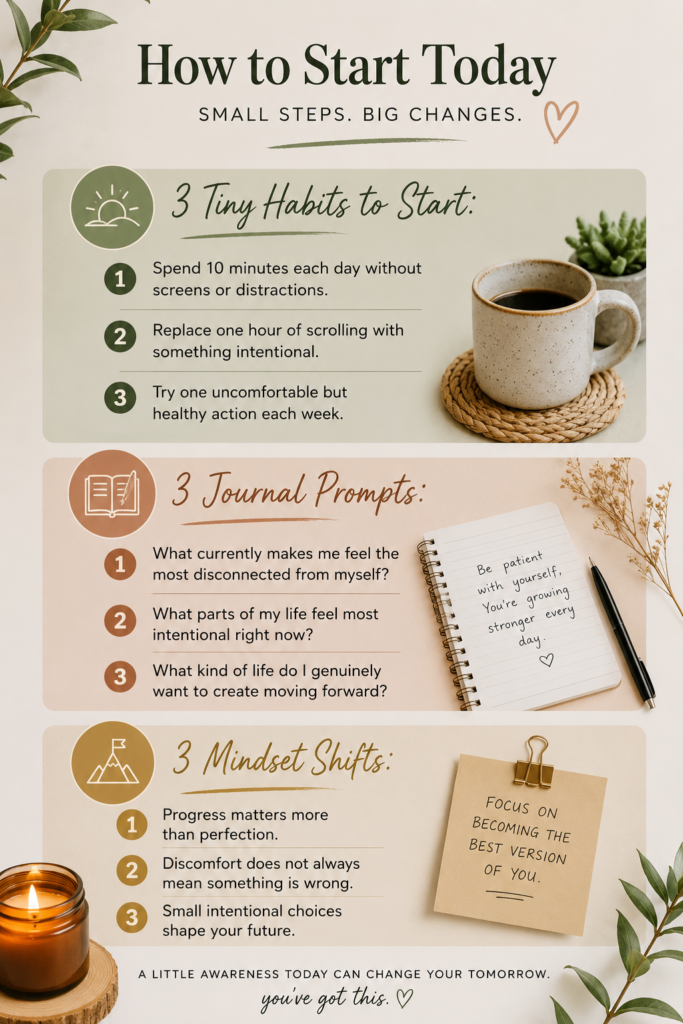
How to Start Today

You do not need to completely reinvent your life overnight.

You simply need to begin waking up a little more each day.

3 Tiny Habits to Start:

  1. Spend 10 minutes each day without screens or distractions.
  2. Replace one hour of scrolling with something intentional.
  3. Try one uncomfortable but healthy action each week.

3 Journal Prompts:

  • What currently makes me feel the most disconnected from myself?
  • What parts of my life feel most intentional right now?
  • What kind of life do I genuinely want to create moving forward?

3 Mindset Shifts:

  • Progress matters more than perfection.
  • Discomfort does not always mean something is wrong.
  • Small intentional choices shape your future.
 

How to stop living on Autopilot


Life moves quickly.
Faster than we often realize.

And if we are not careful, we can spend years preparing to live instead of actually living.

So slow down.
Reconnect with yourself.
Challenge your comfort zone.
Protect your peace.
Take the first small step forward.

You deserve to feel present in your own life again.



How to Stop Living on Autopilot: A Practical Guide to Becoming More Intentional

How to Stop Living on Autopilot: A Practical Guide to Becoming More Intentional

Welcome to this Habitual Balance guide on breaking free from autopilot living and creating a more intentional life. If you’ve been feeling emotionally exhausted, mentally disconnected, stuck in repetitive routines, or simply like life has started blending together, you’re definitely not alone. Many of us spend years moving through responsibilities, distractions, and expectations without slowing down long enough to ask ourselves whether we’re truly enjoying the direction we’re headed in. This guide is here to help you reconnect with yourself, challenge unhealthy patterns, embrace growth, and begin making small but meaningful changes that create a more fulfilling life over time. You do not need to completely reinvent yourself overnight. You simply need to start becoming a little more aware, intentional, and present each day.

1. Recognize the Signs of Autopilot Living

Sometimes we become so consumed by routines that we stop questioning whether those routines are actually making us happy.

Autopilot living often feels “normal,” which is why it can be difficult to recognize at first. Many people wake up, scroll endlessly through their phones, rush into work, come home exhausted, consume entertainment for hours, sleep, and repeat the cycle over and over again without ever slowing down enough to think deeply about their lives.

Signs You May Be Living on Autopilot:

  • Constant doom scrolling
  • Feeling emotionally numb or disconnected
  • Repeating the same routines daily without excitement
  • Living mostly for weekends or vacations
  • Staying busy to avoid deeper thoughts
  • Feeling mentally exhausted even after resting
  • Rarely trying new things or challenging yourself

The scary part is that many people stay trapped in these cycles for years because they assume this is simply what adulthood is supposed to feel like.

But life should feel experienced, not merely tolerated.

Small Action Step:

Spend one full hour today without:

  • your phone
  • television
  • social media
  • notifications

Go outside. Sit quietly. Journal. Take a walk. Let your mind breathe for a while.

2. Stop Overthinking Every Next Step

One of the biggest traps that keeps people stuck is overthinking.

Many of us convince ourselves that we’re making progress simply because we’re constantly thinking about improving our lives. But thinking and doing are not the same thing.

Overthinking often creates paralysis:

  • waiting until the timing feels perfect
  • waiting until you feel fully confident
  • researching endlessly without action
  • comparing your timeline to everyone else’s

The truth is that clarity usually comes after movement, not before it.

What Overthinking Can Look Like:

  • Starting and stopping goals repeatedly
  • Fear of making the wrong choice
  • Constantly needing reassurance
  • Putting dreams on the “back burner”
  • Avoiding action because you don’t feel “ready”

Habit to Try:

Implement the “5 Minute Rule.”

Choose one meaningful goal and commit to working on it for just five minutes each day.

That’s it.

Five focused minutes:

  • writing
  • exercising
  • meditating
  • learning a skill
  • organizing your life
  • building a business idea

Small actions repeated consistently create massive changes over time.

3. Build Long-Term Growth Instead of Chasing Quick Fixes

Personal growth is not a quick transformation.
It’s a long game.

We live in a culture obsessed with instant results, but meaningful change usually happens quietly and slowly. Most of the time, growth is happening underneath the surface long before anyone notices it, including yourself.

That can feel frustrating.
But it’s normal.

Truths About Long-Term Growth:

  • Growth is rarely linear
  • Motivation comes and goes
  • Consistency matters more than intensity
  • Healing takes time
  • Identity shifts happen gradually
  • Small habits shape long-term outcomes

There may be moments where you feel stuck or discouraged because your life is not changing as quickly as you hoped. But if you continue taking intentional steps forward, progress will eventually compound.

30-Day Challenge:

Choose ONE area of life to intentionally improve for the next month:

  • sleep
  • nutrition
  • movement
  • reading
  • mindfulness
  • journaling
  • reducing screen time
  • financial habits

Do not try to fix your entire life at once.

Focus on one area and build momentum slowly.

Reminder:

Your journey does not need to look like anyone else’s to still be meaningful.

4. Learn to Become Comfortable Being Uncomfortable

Growth often requires discomfort.

Many of us spend years avoiding anything that feels emotionally difficult:

  • hard conversations
  • vulnerability
  • failure
  • rejection
  • uncertainty
  • physical discomfort
  • emotional honesty

But avoiding discomfort usually creates even deeper suffering over time.

Sometimes the pain we avoid today becomes the life we feel trapped in tomorrow.

The reality is that some discomfort is necessary if we want to grow stronger mentally, emotionally, or physically.

Discomfort Can Look Like:

  • setting healthier boundaries
  • trying new experiences
  • speaking honestly
  • exercising consistently
  • confronting fears directly
  • changing unhealthy habits
  • stepping outside comfort zones

Pain is not always destructive.
Sometimes it is transformative.

Reflection Prompt:

Ask yourself:

“What discomfort am I currently avoiding that could actually improve my life?”

Write down your answer honestly.

You may be surprised by what surfaces.

5. Start Creating a Life You Actually Enjoy

At some point, many of us realize we do not want to merely survive life anymore.

We want more:

  • more peace
  • more freedom
  • more presence
  • more experiences
  • more connection
  • more meaning

But thriving does not always require a dramatic life overhaul.

Sometimes thriving starts with intentionally creating small moments that make you feel alive again.

Ways to Thrive More Intentionally:

  • Schedule small adventures
  • Spend less time consuming content
  • Build hobbies outside of work
  • Prioritize experiences over distractions
  • Create boundaries around your energy
  • Spend more time in nature
  • Practice gratitude more consistently
  • Slow down enough to actually enjoy your life

The little things matter more than we often realize.

Mini Challenge:

Plan one intentional experience for yourself this month:

  • hiking
  • camping
  • visiting a new coffee shop
  • taking a solo day trip
  • attending a class
  • trying a new hobby
  • spending a day offline
  • reconnecting with an old passion

Life feels more meaningful when we actively participate in it.

How to Start Today

You do not need to completely reinvent your life overnight.

You simply need to begin waking up a little more each day.

3 Tiny Habits to Start:

  1. Spend 10 minutes each day without screens or distractions.
  2. Replace one hour of scrolling with something intentional.
  3. Try one uncomfortable but healthy action each week.

3 Journal Prompts:

  • What currently makes me feel the most disconnected from myself?
  • What parts of my life feel most intentional right now?
  • What kind of life do I genuinely want to create moving forward?

3 Mindset Shifts:

  • Progress matters more than perfection.
  • Discomfort does not always mean something is wrong.
  • Small intentional choices shape your future.


How to stop living on Autopilot


Life moves quickly.
Faster than we often realize.

And if we are not careful, we can spend years preparing to live instead of actually living.

So slow down.
Reconnect with yourself.
Challenge your comfort zone.
Protect your peace.
Take the first small step forward.

You deserve to feel present in your own life again.



Hey friends! I’d like to let my favorite people of the internet world (that’s you) 😊 know that the products mentioned or linked to in these posts may be affiliated in some part with Amazon or another party. By doing so, this allows me to continue creating valuable content to share at no extra cost to you if you were to use those links to purchase a recommended product. Thank you as always for your support along this journey and for being the awesome human being that you are!

More From Habitual Balance

Leave a Reply

Your email address will not be published. Required fields are marked *